
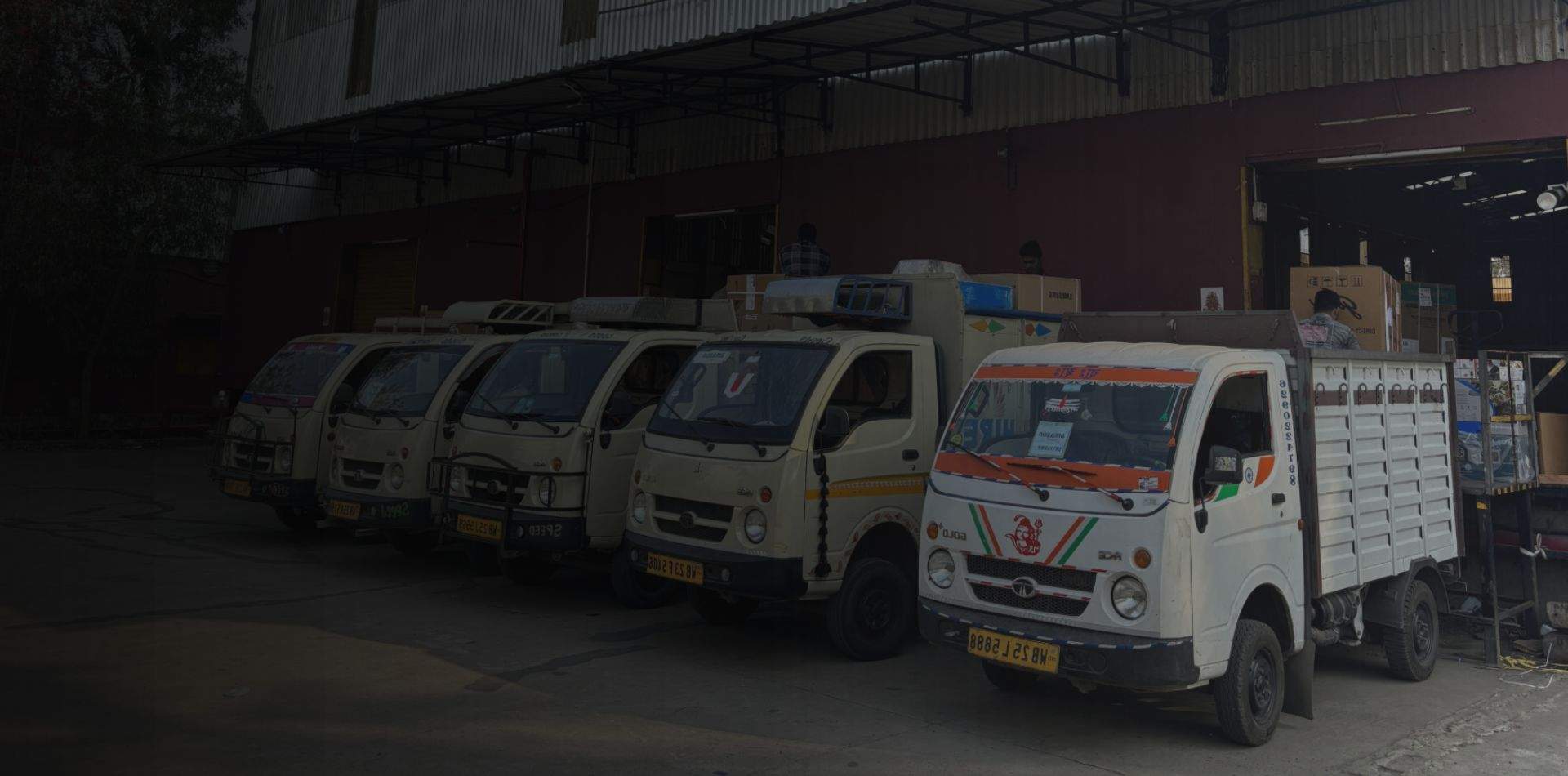


How We Move 500 Vehicles Across 23 Districts in a Single Day
A large deployment is not one big job. It is several hundred small ones that have to agree with each other, and the planning starts four days before anything moves.
When a client asks whether we can put five hundred vehicles on the road on the same morning, the honest answer is that the number is rarely the hard part. The fleet exists. What has to be built, every single time, is the agreement between four hundred drivers, twenty-three district coordinators and a client whose warehouse can realistically load nine trucks an hour rather than ninety.
This is a walk through how one of those days is actually put together, using a consumer-goods rollout we ran last season as the example.
Four days out: the load plan
Nothing is booked until we know what is going on each vehicle. A TATA ACE carrying cartons of packaged food is a different planning problem from a Bolero pickup carrying the same weight in loose crates, because the second one needs two people at the unloading end and the first does not.
We build the plan around the constraint that will not move, which is almost never the vehicles:
- Loading bay capacity at the origin, measured honestly rather than optimistically.
- Delivery windows at the far end, particularly anywhere that closes for a long lunch.
- Driver hours, so nobody is asked to finish a run they should not have started.
- The two or three routes that will be slow whatever we do, which get the earliest slots.
Two days out: district coordinators
Each of the twenty-three districts gets one named person who owns it. That person is not a dispatcher sitting in Kolkata with a spreadsheet. They are local, they know which approach road floods, and they have the phone number of the person who actually opens the gate.
The single biggest improvement we ever made to large deployments was giving every district one name and one number, instead of a central desk that everybody rang at once.
The night before: staging
Vehicles are staged near their first pickup rather than at a central yard. It costs a little more in dead running and it saves several hours across the fleet, because nobody spends the first productive hour of the morning driving to where the work is.
On the day: what we actually watch
Once vehicles are moving, the dashboard narrows to three things. Everything else is noise until one of these three is wrong.
- Vehicles that have not reported movement within forty minutes of their slot.
- Any district running more than an hour behind its own plan.
- Proof of delivery that has not come back by mid-afternoon.
A deployment of this size never runs exactly to plan, and it is not supposed to. What it has to do is fail in small, contained ways that a district coordinator can absorb without ringing anybody. That is the whole design goal.
What we would tell a first-time client
Tell us your real loading rate, not the one in the contract. Every hour of optimism at the origin becomes three hours of delay somewhere in Purulia, and it is much cheaper to plan around a slow bay than to discover one.
Comments (05)
Leave a Reply
Your email address will not be published. Required fields are marked *
Sandeep Roy
Sep 17, 2026 at 2:30 amThis is the first piece I have read that admits the loading bay is the bottleneck. We spent two years blaming our transporter before we measured our own dock.
RD Transport Owner
Sep 17, 2026 at 2:30 amThank you - that measurement is genuinely the most useful hour a client can spend before a big rollout. Happy to send you the simple tally sheet our coordinators use if it would help.
Meghna Bhattacharya
Sep 18, 2026 at 2:30 amDo the district coordinators handle returns as well, or is that a separate team? We have a lot of reverse logistics and it is usually where things fall apart for us.
Sourav Saha
Sep 20, 2026 at 7:03 pmGood job
RD Transport Owner
Sep 20, 2026 at 7:03 pmThanks